


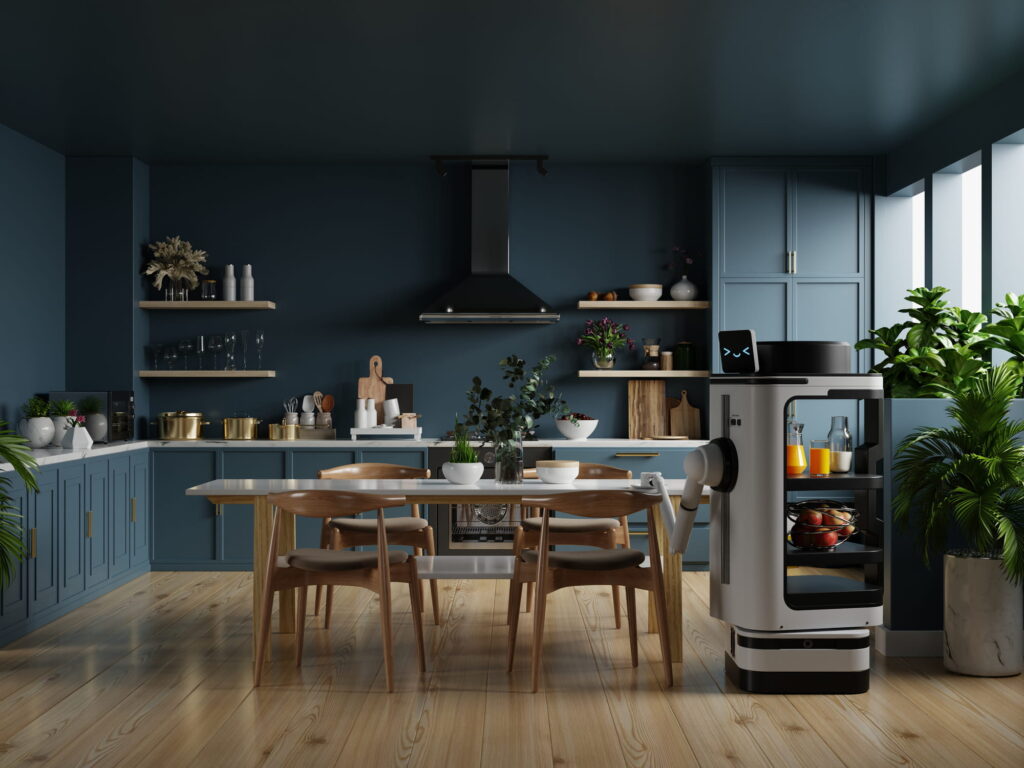
The definition of a luxury kitchen has officially shifted from high-end finishes to high-tech functionality. For decades, homeowners judged a kitchen by the quality of its stone countertops or the professional grade of its range. However, as we move through 2026, the arrival of multi-skilled domestic robots has changed the architectural landscape. These autonomous assistants now handle everything from loading dishwashers to prepping ingredients and folding laundry. Consequently, forward-thinking homeowners no longer settle for standard layouts. They demand a robot-ready home that accommodates the next generation of household AI without sacrificing style.
The Evolution of the Domestic Workspace
Domestic robots require more than just a Wi-Fi connection to operate effectively. Unlike human occupants who can navigate tight corners and step over obstacles, early-generation autonomous assistants thrive in environments with specific spatial parameters. A traditional kitchen often features narrow walkways and dead-end “U-shapes” that trap a robotic unit. To avoid these bottlenecks, builders now design kitchens with wider clearances and circular flow patterns.
By investing in a robot-ready home, you ensure that your domestic assistants move fluidly between the pantry, the prep station, and the cleaning zone. This spatial planning prevents mechanical frustration and allows the AI to complete its tasks with maximum efficiency. We now prioritize minimum five-foot clearances in high-traffic zones to allow for the “passing width” of both human residents and their mechanical helpers. This foresight transforms the kitchen from a site of labor into a hub of automated convenience.
Pre-Planning for Automation: The New Construction Standard
Many homeowners view robotics as a future possibility rather than a present reality. Nevertheless, the cost of retrofitting a completed house for automation far exceeds the cost of initial planning. Savvy builders emphasize that pre-planning for automation protects the long-term value of a custom build. If you design your utility rooms and kitchens with integrated charging infrastructure now, you avoid expensive renovations five years down the road.
This proactive approach involves more than just adding extra outlets. We design recessed charging docks into the base of kitchen islands and utility cabinets. These “garages” allow robots to self-dock and recharge out of the line of sight, preserving the clean aesthetic of your home. Furthermore, we install reinforced flooring in these docking zones to handle the constant weight and movement of heavier industrial-grade domestic units.
Specialized Storage for Mechanical Assistants
A truly autonomous kitchen requires specialized storage solutions for the tools that robots use. While humans store dishes in high upper cabinets, many current domestic robots operate more efficiently within a lower reach-range. Therefore, we design “smart cabinetry” with motorized drawers that open upon an AI’s signal. This collaboration between the architecture and the machine ensures a seamless workflow.
Furthermore, we integrate specialized storage for laundry-folding and dish-loading attachments. These accessories often require dedicated space near the primary work zones. In a robot-ready home, the utility room acts as a docking station where the assistant can switch out its “hands” for different tasks. We plan these zones with precision, ensuring that the robot can access its own tools without human intervention. This level of autonomy represents the true promise of the zero-labor kitchen.
Flooring and Threshold Transitions
The success of a domestic robot depends heavily on the surfaces it traverses. Deep grout lines, high transitions between rooms, and plush area rugs often impede an autonomous unit’s sensors. To solve this, we utilize “zero-threshold” flooring throughout the main level of the home. By maintaining a perfectly level surface from the kitchen to the dining room, we allow the robot to transport heavy trays or cleaning supplies without risk of tipping.
In addition to level transitions, we select flooring materials with optimal “grip” and durability. Modern robot-ready home designs favor large-format porcelain or engineered stone with a matte finish. These surfaces provide the necessary traction for robotic wheels while resisting the wear and tear of constant mechanical traffic. When the architecture supports the machine’s movement, the entire household experiences a higher level of service.
Future-Proofing the Utility Room
The utility room serves as the “brain” of the automated house. Beyond laundry machines, this space now houses the central server and the primary maintenance bay for domestic AI. We design these rooms with enhanced ventilation systems to manage the heat generated by constant charging and data processing. A robot-ready home requires a sophisticated electrical grid capable of handling multiple high-draw devices simultaneously.
By dedicating space for a technical bay, you ensure that your home remains compatible with the AI hardware of 2030 and beyond. This infrastructure supports the software updates and hardware upgrades that define the fast-moving tech sector. You are not just building a room; you are building a flexible platform for the future of domestic life.
The Financial Advantage of Robot-Ready Design
From a resale perspective, a home that accommodates automation holds a significant advantage in the luxury market. Buyers in 2026 and beyond will view a lack of “robot-readiness” as a major drawback, similar to a home lacking high-speed internet in the early 2000s. Investing in a robot-ready home today secures your position at the top of the real estate market for the next decade.
We help you navigate the complexities of these new requirements without losing the “soul” of your custom home. Technology should serve the design, not dictate it. Our goal is to hide the infrastructure while providing the maximum benefit of the AI revolution. When the “labor” of the kitchen disappears into the background, you gain the freedom to focus on what truly matters: enjoying your home with your family.
Designing Your Autonomous Future
The transition to a zero-labor lifestyle represents one of the most exciting shifts in residential history. By embracing the requirements of autonomous assistants, we unlock a new level of luxury and convenience. It is time to think beyond the backsplash and start thinking about the workflow of your future household.
Let us help you create a robot-ready home that anticipates your needs and manages your chores. Our team specializes in the intersection of traditional craftsmanship and cutting-edge automation. We invite you to explore our new floor plans designed specifically for the next decade of household AI.