


Texas summers regularly bring triple-digit temperatures and relentless solar radiation that drives homeowners indoors for months. Most homeowners rely exclusively on heavy air conditioning systems to maintain thermal comfort throughout the long summer season. However, forward-thinking luxury home builders look beyond mechanical HVAC units to ancient thermodynamic principles. By incorporating modern subterranean architectural techniques, custom builders craft outdoor living spaces that stay up to fifteen degrees cooler than the ambient air. Implementing sunken courtyard passive cooling allows Texas homeowners to enjoy comfortable outdoor living even during the hottest July afternoon. Understanding these thermal engineering strategies helps you design a custom residence that fights extreme heat naturally.
The Thermodynamic Science of Subterranean Spaces
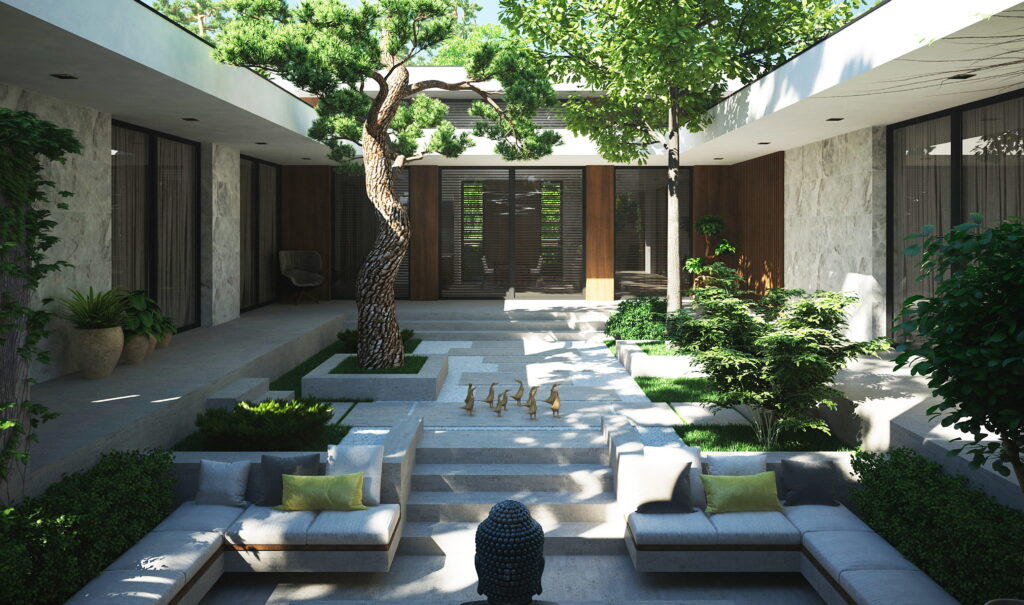
Lowering an outdoor courtyard six to ten feet below the surrounding grade fundamentally alters how heat interacts with the space. Earth temperatures beneath the surface remain substantially cooler and more stable than the scorching air above ground. This subterranean depth creates an immediate physical barrier against radiant ground heat and prevailing hot surface winds. Furthermore, dense earth acts as a natural heat sink that continuously absorbs excess thermal energy throughout peak daylight hours. Custom builders leverage sunken courtyard passive cooling to establish a localized thermal reservoir that retains cool air near the floor.
Because cool air naturally weighs more than warm air, dense air sinks to the lowest architectural point and remains trapped inside the courtyard walls. This natural thermal stratification protects occupants from the high heat indexing happening at ground level. Additionally, utilizing sunken courtyard passive cooling maximizes the thermal dampening effect of surrounding subsoil. Thick masonry retaining walls store cool nighttime temperatures and gradually release that thermal energy as ambient heat rises. Establishing this passive thermal cycle ensures that the subterranean courtyard maintains a significantly lower mean radiant temperature.
Thermal Mass and Masonry Wall Engineering
Selecting the proper building materials plays a decisive role in the long-term thermodynamic performance of lower-level courtyards. Custom builders utilize dense masonry materials like native Texas limestone, rammed earth, and reinforced concrete for subterranean retaining walls. These materials possess high thermal mass capacity, allowing them to absorb immense amounts of heat without instantly transferring warmth into the living zone. Furthermore, builders line northern and western courtyard faces with high-density stone to block harsh afternoon solar radiation effectively.
Combining heavy stone walls with sunken courtyard passive cooling creates an enduring buffer against extreme climate swings. During cooler summer nights, the open courtyard radiates stored daytime heat directly into the night sky through radiative cooling. By the time morning arrives, the masonry surfaces have cooled down completely and stand ready to absorb the next heat cycle. Therefore, proper material selection transforms structural retaining walls into active temperature-regulating systems.
Architectural Shade Funnels and Aerodynamic Airflow
Direct sunlight rapidly neutralizes any subterranean cooling effect if architects fail to control solar radiation. Custom home designers engineer precise architectural shade funnels, deep roof overhangs, and cantilevered trellises over lower courtyards. These strategic overhead structures calculate solar angles to block high summer sun while allowing ambient natural daylight to filter down smoothly. Consequently, minimizing direct solar exposure keeps surface temperatures inside the courtyard from spiking during peak afternoon hours.
Aerodynamic design also dictates how air moves into and out of the lowered outdoor space. Custom builders engineer microclimate ventilation channels that capture prevailing summer breezes high above the roofline. As air passes across the top of the courtyard, it draws warm air out from the lower level through the Venturi effect. Incorporating sunken courtyard passive cooling into these aerodynamic layouts generates gentle, continuous air movement without blowing hot surface dust into the living area.
Integrating Evaporative Bio-Cooling Elements
Water features and native vegetation elevate passive courtyard cooling performance from simple shade to active bio-cooling. Introducing shallow pool basins, vertical water walls, or fountain jets into a lowered courtyard introduces natural evaporative cooling. As dry summer air passes over the water surface, thermal energy evaporates water droplets and drops surrounding air temperatures rapidly. Furthermore, dense foliage and native plants release moisture into the microclimate through natural transpiration.
Placing lush vegetation along the floor of the courtyard amplifies the refreshing physiological impact of sunken courtyard passive cooling. Strategic plantings shade subterranean stone surfaces, preventing masonry from heating up during peak solar hours. Additionally, falling water creates soothing acoustic feedback that dampens surrounding urban noise while actively refreshing the local air. Combining water elements and dense landscaping transforms a simple concrete pit into an inviting, high-performance oasis.
Enhancing Home Equity and Modern Texas Living
Building a subterranean microclimate fundamentally alters how families interact with their outdoor spaces throughout the Texas summer. Rather than abandoning patios to scorching temperatures, homeowners gain a private, temperature-controlled sanctuary for dining, entertaining, and relaxing. Furthermore, surrounding the primary residence with cool microclimates reduces heat transfer into adjacent interior rooms, lowering overall air conditioning demands. Investing in sunken courtyard passive cooling enhances the architectural character, energy resilience, and resale value of custom Texas estates. Modern luxury design proves that leveraging ancient thermal mechanics provides the ultimate balance between sustainability and outdoor comfort.